
The Final Design Decision You’re Probably Skipping
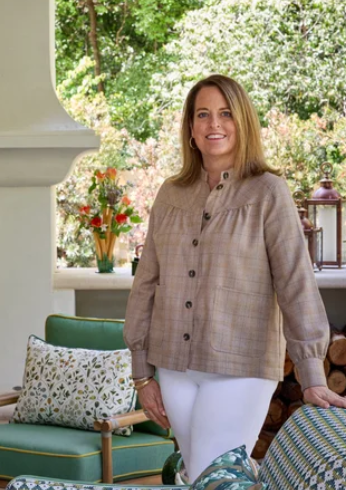
In this Think Like A Designer episode, I sit down with Liz Williams — an interior designer based in Atlanta, Georgia, known for her work with symmetry, elegance, and what I've started calling the last decision — to look through a curated selection of her portfolio. We move through a grand formal home on the Chattahoochee River, a barn conversion in Madison, Georgia, a show house primary bedroom in a high-rise, and several other projects, stopping at the details that most rooms never get and most homeowners talk themselves out of.
The last decision is the finishing detail: the trim on the pillow gusset, the tape on the curtain hem, the nail head tracing the curve of a wingback chair. Not the focal point, not the statement piece — the thing that comes after all of those, when a room is almost done but not quite complete. Liz takes this step in every room she designs, across every style and scale. And once you see it, you understand immediately what most rooms are missing.
The slide deck from this episode is available below — browse the portfolio images alongside the takeaways, or watch the full episode as a subscriber.
With your monthly subscription, you'll have access to exclusive, full length episodes, both audio and video. After signing up, you'll receive an email with easy instructions on how to add this premium show to your podcast player (Apple, Spotify, etc). And every week, you'll receive a link to the video version. As you may know, in the audio version, I make a strong effort to describe the designs we're looking at. But if you want to see everything for yourself, you'll want to click the link to the video version we'll be sending you.
KEY TAKEAWAYS
The last decision: the finishing detail most rooms never get
The most common reason a room feels almost-but-not-quite isn't the sofa or the rug or the art — it's the absence of a finishing detail that most people skip without realizing they're skipping it. In Liz's portfolio, this detail takes a different form in every room: a band of woven trim on a boxed pillow gusset; pleated lampshades coordinated to the palette of the painting above the fireplace; a café curtain with a Greek key border in a dormer bathroom. None of these is the focal point. All of them are what make the room complete.
Why we skip it — and what that's really about
Most people skip the finishing detail for one of three reasons: it seems too formal for their home, too fussy for their taste, or not worth the extra cost. All three are versions of the same quiet belief: that level of care is for someone else's home. That belief is worth examining. The finishing detail is not a formal gesture — it appears in Liz's barn bunk room just as naturally as in her grand Winterthur living room. It's a decision about whether to go all the way. And it's available at every budget and in every style.
Symmetry as a foundation for playfulness — not just formality
In the Winterthur home, a matching pair of two-legged marble-topped consoles flanks the doorway from the entry into the living room — each with a blue and white chinoiserie ginger jar and an ornate mirror above. The symmetry is formal, but Liz describes it as a background: a stable, peaceful structure that makes the colorful and playful elements elsewhere in the room feel grounded rather than chaotic. Symmetry gives you permission to take risks elsewhere.
How to mix painted wood and raw wood in the same room
In a kitchen featured in the episode, mint-green painted cabinetry pairs with a raw wood island countertop and three simple raw wood bar stools. The contrast works because each finish is doing a different job: the painted surface is refined and unified; the raw wood adds age, texture, and patina. The pendant shades above the island — originally plain white drums — were taken down and fitted with a band of dark mossy green trim at the top and bottom edges, creating a horizontal rhythm that ties together the island, the stools, and the pendants into a single coherent plane.
How to renovate a barn without making it feel like a cabin
The Madison, Georgia barn is dark and rustic on the exterior — stone, timber, weathered — and bright and resolved inside. The walls are painted white shiplap, which reads as crisp rather than cold because of the warm caramel tones in the leather side chairs, the stone fireplace, and the mounted deer heads. The palette was drawn from the landscape outside — blues and greens from the sky and trees, caramel from the stone — so the interior feels like an extension of the setting rather than a departure from it.
Curtains the same color as the walls: why it works
In a show house primary bedroom — a small, high-ceilinged room — Liz hung curtains in the same cream as the walls, running them floor to ceiling just below the crown molding. The effect is softness: the corners of the room recede, the walls feel continuous, and the room reads as larger than it is. The punch comes entirely from the trim — custom-made from linen because she couldn't find what she wanted — worked into the leading edge of each panel. The curtains disappear into the room; the detail is what you see.
The vignette as a design problem to solve
In a pool-adjacent living room, Liz faced a wall that needed height and interest but couldn't take another oil painting. Her solution: three vintage French farm tools hung in a graphic arrangement — two with their round ends facing up, one in the center with the round end facing down. Beneath them, a reclaimed-wood slatted cabinet (housing pool towels) topped with marble, a succulent in a rustic container, and an iron lamp made from a salvaged fragment. The materials mix — glass, iron, marble, reclaimed wood, ceramic, a painted shorebird — is what makes the vignette feel alive rather than arranged.
Liz Williams is an interior designer based in Atlanta, Georgia. Find more Think Like A Designer episodes and full show notes at SlowStyleHome.com/podcast.
Links mentioned in the episode:
Liz’s Website
Press Play Below To View The Slide Deck From The Episode