
Buying Art, Simplified with Liz Lidgett
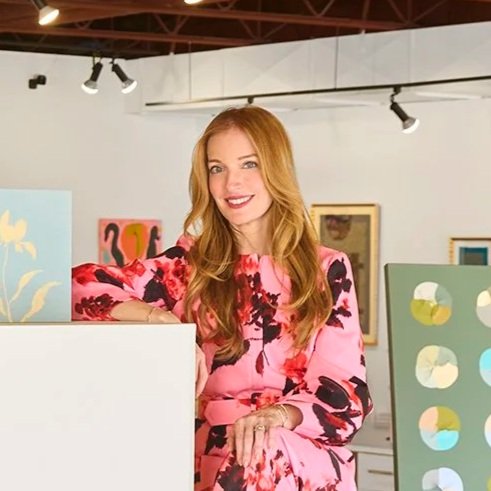
I keep thinking about how often we walk into a gallery already convinced we don’t belong there and how quickly that belief starts to shape what we choose. In this week's episode, I sit down with gallery owner Liz Lidgett to talk about her new book “Art For Everyone”. Because collecting art isn’t about having the right words or the right budget, it’s about being willing to notice your own reactions and trust them. We talked about how your taste develops through exposure—by looking at a lot of art, by saying no without apology, and by getting curious about why something pulls you in. A good gallerist isn’t there to judge you; they’re there to help you translate those instincts into something tangible. And yes, we got into the practical side: price, scale, the mistake of buying small just because it feels safer, but what matters more is understanding that art isn’t meant to match your room, it’s meant to lead it. When you let yourself buy from that emotional place, you’re not just filling a wall, you’re creating a home that reflects you in a way nothing else really can.
KEY TAKEAWAYS
I keep coming back to this idea: most of us walk into a gallery already convinced we don’t belong there. We assume there’s a right way to look at art, a right thing to say, a level of knowledge we’re supposed to have before we’re “allowed” to buy anything.
This episode with Liz Lidgett is really about dismantling that from the inside out.
Because the truth is, collecting art has very little to do with expertise and everything to do with attention. Noticing what pulls you in. Letting yourself feel something before you try to explain it. And trusting that reaction, even if you don’t yet have the language for it.
Liz has built her entire gallery—and her book Art Is for Everyone—around this idea: that art should be accessible, emotionally driven, and deeply personal. Not performative. Not intimidating. Not reserved for someone else.
Start With Feeling, Not Matching
One of the biggest shifts we talked about is moving away from the idea that art needs to “go with” your room.
Because it doesn’t.
In fact, that mindset is exactly what keeps people stuck—choosing safe, neutral, mass-produced pieces that offend no one and say nothing.
Instead, Liz encourages starting with emotion. What’s the piece you can’t stop looking at? What makes you feel something in your body before your brain has time to catch up?
Because here’s the truth: your navy sofa is temporary. Your art is not.
Art is the thing you’ll live with for years—maybe decades. It’s the piece your eye lands on every single day. It’s what your kids will remember hanging on the walls.
So the question shifts from “Does this match?” to “Does this move me?”
You Don’t Need to Know What You Like Yet
A lot of people think they’re supposed to walk into a gallery with fully formed taste.
You’re not.
In fact, Liz made it very clear—that’s the whole point of the process.
You start by looking at a lot of art. Not once, but over time. You react. You say yes, maybe, no. And just as importantly, you explain why.
Not in polished, art-world language—but in real terms:
“That color makes me anxious.”
“I had a bad experience on a boat, so I don’t want that imagery.”
“I love how thick the paint looks.”
“There’s something about the light in this one.”
That’s the work.
And a good gallerist is listening for those cues, connecting the dots, and helping you see patterns you might not even realize are there yet.
What a Gallerist Actually Does (Hint: It’s Not Judging You)
There’s this lingering myth that galleries are cold, unwelcoming spaces where you’re expected to quietly observe and not ask questions.
It’s completely backwards.
Gallerists choose this work because they love art and they want to talk about it. They want to tell you about the artist, the process, the intention behind the piece. They want to help you find that aha moment where something clicks.
Liz described her role as part curator, part matchmaker.
She’s not waiting for you to impress her. She’s trying to understand you—how you live, what you’re drawn to, what you do on a Saturday afternoon—and then connect that to the work in front of you.
So instead of holding back, this is where you lean in:
Ask questions. Stay longer. Go back more than once.
There’s no expectation that you’ll buy something the first time you walk in.
Let’s Talk About Price (Because Everyone Is Thinking About It)
Art pricing feels opaque because, for a long time, it was.
But Liz pulled back the curtain in a way that makes it much more approachable.
Many artists price their work by square inch, with a multiplier that reflects their experience and career:
Emerging artists might be around $2 per square inch
More established artists might be $5.50 (or more)
That means size matters—but it’s not the only factor. Pricing also reflects:
The artist’s exhibition history
Whether they’re collected by museums
Their career trajectory
Whether they’re living or not
And then there are the hidden costs people don’t always think about:
Framing
Shipping (often around 10% of the piece’s cost)
Installation
All of this is why so many people say, “I don’t even know what my budget is.”
And that’s okay.
You learn your comfort level over time—just like anything else. Maybe your first piece is $500 and that feels like a stretch. Years later, you’re spending more because you’ve built trust in your own taste.
Stop Buying Small Just Because It Feels Safer
This is one of those moments where I had to say it plainly: don’t default to the smaller piece just because it’s cheaper.
Because what often happens is you bring it home… and it disappears on the wall.
So then you buy another small piece. And another. And suddenly you’ve spent the same amount you would have on one larger, more impactful piece—but without the presence.
Scale matters.
And sometimes the braver choice—the bigger piece—is actually the more satisfying one in the long run.
Collecting Over Time (Not All at Once)
There’s no finish line here. No perfectly “complete” collection.
Instead, collecting art is something that unfolds over years—and can take many different shapes depending on your approach.
Some people:
Buy one piece every year for a milestone (a birthday, an anniversary)
Collect in pairs, then threes, then fours to reflect their family
Focus on a specific era or style
Or, like me, go broad—exploring different mediums, artists, and perspectives
Liz emphasised something I love: you can be intentional without being rigid.
You can follow an artist’s work over time. Join gallery mailing lists. Ask to be notified when new pieces come in. Request a one-sheet about an artist you love so you can remember why it resonated.
It becomes part of your life—not a one-time purchase.
The Fear: “What If I Stop Liking It?”
This is the question that keeps people stuck more than anything else.
And honestly? It’s a fair one.
But here’s what we came back to: if you bought the piece because it created a genuine emotional response, that relationship doesn’t just disappear.
It evolves.
And if something starts to feel different, you don’t have to get rid of it. Move it. Let it live in a new space. Pair it with different pieces. Change the conversation it’s having in the room.
Because that’s what art does—it interacts. It shifts depending on what’s around it and where you are in your life.
Your Home Should Not Look Like a Waiting Room
This might be the most important takeaway.
When you choose art based on what other people will like, you end up with a home that feels… fine. Inoffensive. Forgettable.
But when you choose art based on what you love—even if it’s unexpected, even if someone else doesn’t get it—you create something far more interesting.
You create a home that tells the truth about who you are.
Your walls become a reflection of your experiences, your memories, your curiosity, your point of view.
And that’s the whole point.
Where to Begin (If You’re Still Hesitating)
Start here:
Walk into a gallery (yes, really)
Look at everything
Notice your reactions
Ask questions
Leave without buying anything if you’re not ready
Go back again
And when something finally clicks—when you feel that pull you can’t quite explain—trust it enough to take the next step.
Because art isn’t the finishing touch.
It’s the thing that makes your home feel like yours.
Until Next Time
-Zandra
Links Mentioned In The Episode
Liz’s Website
Liz’s Book