
Inside Sean Leffers’ Poetic Mix of Cultures, Eras, and Story
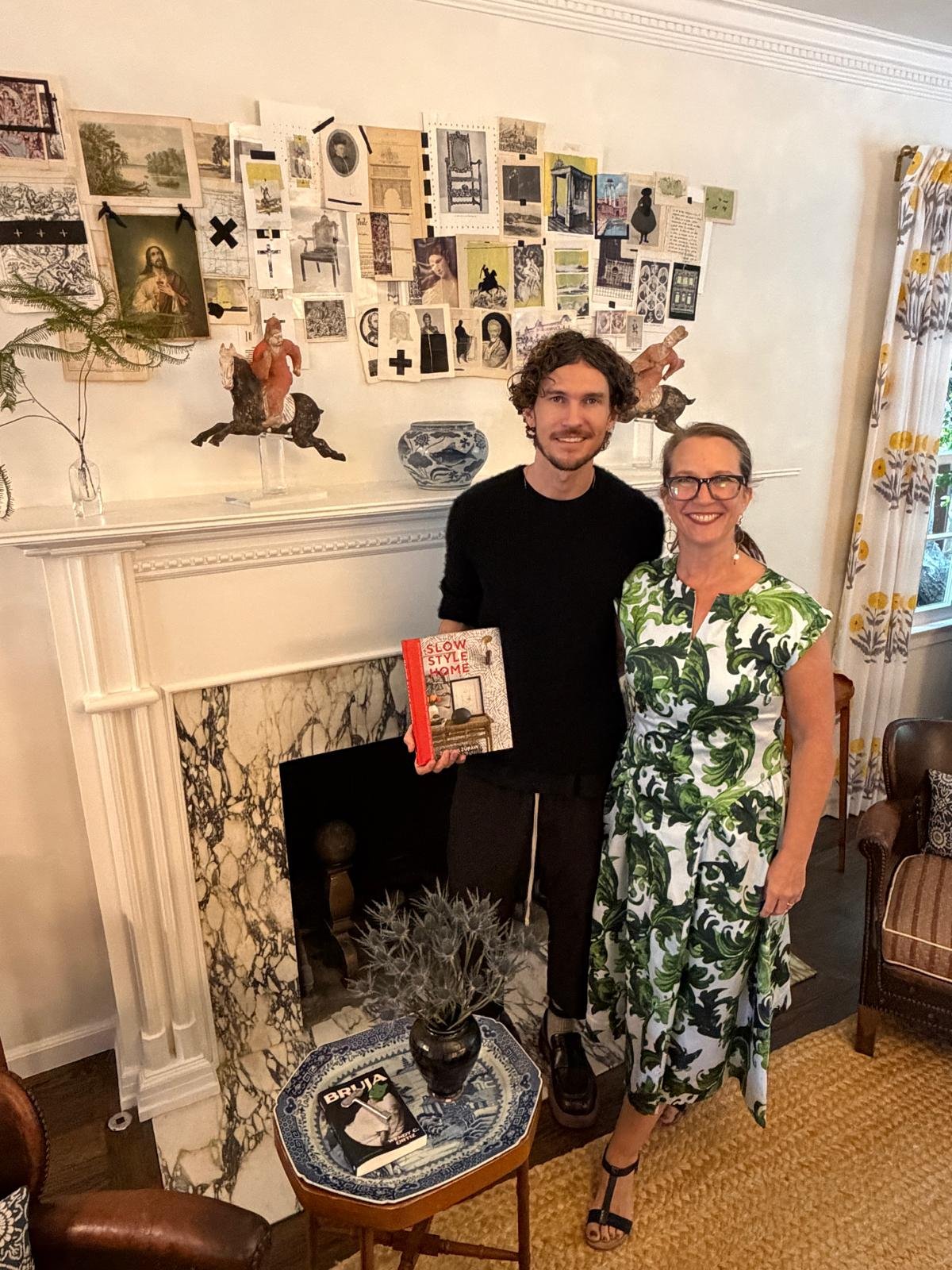
In this episode, I have the absolute pleasure of stepping inside the Los Angeles home of designer Sean Leffers—someone whose work I admire for its depth, sensitivity, and extraordinary sense of narrative. From the moment we walk through the door, it’s clear that Sean doesn’t decorate; he curates a life. His rooms are layered with art, antiques, travel finds, spiritual references, and handmade pieces that carry memory and lineage.
As we tour, Sean shares the stories behind Japanese metalwork born from peacetime, Brazilian and Sri Lankan furniture, colonial Peruvian carving, block-printed textiles from India, and contemporary works by artists he loves and champions. We talk about how culture travels, how objects evolve across borders, and why the blurred line between art and craft makes a home feel human.
Most of all, this episode is about connection. Each vignette becomes an invitation—to ask questions, to linger, to see more. If you want a home that feels personal, soulful, and deeply lived in, this conversation is full of inspiration.
KEY TAKEAWAYS
I recently had the absolute pleasure of visiting designer Sean Leffers in his Los Angeles home, and I want to prepare you: this is not a house you simply walk through. It’s a house you experience.
Every object asks something of you. Where am I from? Who made me? How did I travel here? What do I mean?
If you’ve ever wondered how to create a home that feels personal and alive rather than decorated, Sean provides a generous, deeply thoughtful blueprint.
Let me take you inside.
A 1930s House with a New Breath of Life
Sean bought the home about five years ago. It dates to the mid-1930s and was designed in a Southern California interpretation of Neoclassical architecture inspired by Paul Williams. Think symmetry and elegance, yes—but relaxed for a climate that encourages indoor-outdoor living.
One of the most transformative changes Sean made was vaulting the upstairs ceilings. They had been under eight feet tall, and by opening them to the roofline and adding beams, he preserved the comfortable layout while allowing the house to breathe.
I love that balance: honoring what was there, while gently giving it more life.
An Entry That Starts Conversations
The moment you step inside, curiosity takes over.
At the center of the foyer is a round table with a vignette that perfectly captures Sean’s spirit. A Gandharan Maitreya Buddha head—showing both Indian and Greco-Roman influence from ancient trade routes—sits in the middle. Around it? Japanese iron crabs, their pincers raised, almost reverent.
Sean told me these crabs were made after a violent period in Japan, when metalworkers who once forged weapons began creating art and toys instead. Darkness turned into light.
I mean… what a way to be welcomed into a home.
This is what I always hope for: a space that invites connection before anyone has even taken off their coat.
The Powder Room: Where Function Meets Poetry
I’m not sure I’ve ever lingered in a powder room longer.
The wallpaper is a deep cyanotype blue from Mind the Gap, layered and atmospheric. The vanity is Edwardian—likely one of the earliest examples of fine cabinetmaking meeting modern plumbing. And instead of a large mirror encouraging a quick primp, Sean placed smaller tabletop mirrors by a window.
It softens the ritual. It asks you to slow down.
Even here, there’s a Mexican Chippendale table—an English style reinterpreted through another culture and material history. Sean is constantly showing us how design migrates and evolves.
Composing with Meaning (and a Little Humor)
We talked about the idea of a vignette—how it can sound precious but can actually be playful.
Sean’s arrangements change often. He lives with them, experiments, and moves things around. The crabs “worshiping” the Buddha nod to his Cancer zodiac sign. There’s wit, personality, and lightness alongside the scholarship.
Nothing is frozen. Everything is in conversation.
Beauty in the Service Spaces
Sean said something I absolutely loved: when time and budget allow, he likes to invest deeply in service areas like the butler’s pantry.
Why? Because if the places where we work are beautiful, we’re inspired to care for our homes more lovingly.
Yes. Yes. A thousand times, yes.
The original floors remain, stained dark, with painted checkerboard sections that strike this wonderful tension between humble and grand. Art by Gala Porras-Kim hangs nearby, along with a powerful self-portrait by Rafa Esparza, whose work often centers on generosity and community.
When Furniture Carries Social Commentary
A Brazilian Art Nouveau chair by Ze Carlos Garcia stops you in your tracks. Feathers explode from it. The piece speaks about domesticity, queerness, and class.
Turn around, and you’ll see a matching intervention on a traditional screen, topped with shards of glass—a reference to the security measures surrounding wealthy homes in Brazil and the enormous wealth divide there.
Sean doesn’t shy away from complexity. Beauty and discomfort can coexist.
Homes can hold big ideas.
Layering High, Low, Old, and Personal
In the living spaces, centuries and price points collapse into each other.
There’s an Indian caned bench, Indonesian textiles, Pierre Frey pillows, ones from a Santa Fe shop, and needlepoints from Sean’s grandmother. Nearby are his own fabrics inspired by 19th-century Japanese textiles, mixed with Ralph Lauren and even CB2.
Nothing feels snobbish. Everything feels chosen.
I always say it’s not about what things cost—it’s about whether they matter.
Nature as Sculpture
Sean uses tropical fronds you can buy inexpensively, breaking them apart to create dramatic, shadow-casting forms. On the mantel and tables sit scholars’ stones—lingbi or suiseki—traditionally used for contemplation.
You immediately understand why.
They quiet you.
Meditation as Part of the Floor Plan
One of my favorite innovations: Sean designs meditation cushions in his own fabrics and incorporates them into the seating layout.
Instead of hiding spiritual practice, he normalizes it. Makes it beautiful. Makes it communal.
Imagine planning your room around presence.
Ming Polo Players and Feminist Histories
Two Ming dynasty polo figures (long missing their mallets) stand before work by a Chilean artist examining the constraints on women during the colonial era.
I found myself wanting to sit and stare for a long, long time.
That’s the gift of thoughtful collecting—it slows us down.
Revealing the Past
Sean bought a blackened table at auction and, through restoration, uncovered elaborate carvings—mermen and incredible detail—dating to the vice-regal period in Peru, when Spanish and Indigenous traditions merged.
Again, we see this idea of cultures meeting and reshaping one another.
Nothing exists in isolation.
Tea, Silver, and Daily Ritual
In the breakfast room, Sean’s long love of tea is evident: Italian mid-century pieces, silver caddies, beloved patina (sometimes reset after ocean air gets aggressive).
A Swedish Gustavian cabinet holds a figure representing infinite compassion in Buddhism.
Different worlds. One harmony.
What I Hope You Take Away
Sean’s house is layered, yes. Scholarly, yes. But above all, it’s generous.
It invites questions. It makes space for dialogue. It reminds us that when we fill our homes with objects that carry story, we make it easier to connect—to history, to culture, and to each other.
If you want a home with soul, study this one.
And then start asking better questions about what you choose to live with.
Until Next Time
-Zandra
Links Mentioned In Episode:
Sean Leffers website
Paul Williams his architectural style influenced the style of Sean’s home
Aldo Tura Italian mid-century designer
Suiseki (called “lingbi” in China) are Japanese contemplation stones
Gala Porrus-Kim (artist) The first painting in the dining room
Rafa Esparza (artist) Sean said this was a self-portrait of Rafa as Quetzalcóatl, which is an Aztec deity known for uniting earth and sky and the god of wisdom, learning, and intelligence
Ze Carlos Garcia (artist) The chair redone in bird feathers & the caned screen with glass shards
Liora Kaplan (artist) The totem in the dining room
Avolokiteshvara Goddess of infinite compassion